Dygma Raise- World's most advanced gaming keyboard
Created by Luis Sevilla
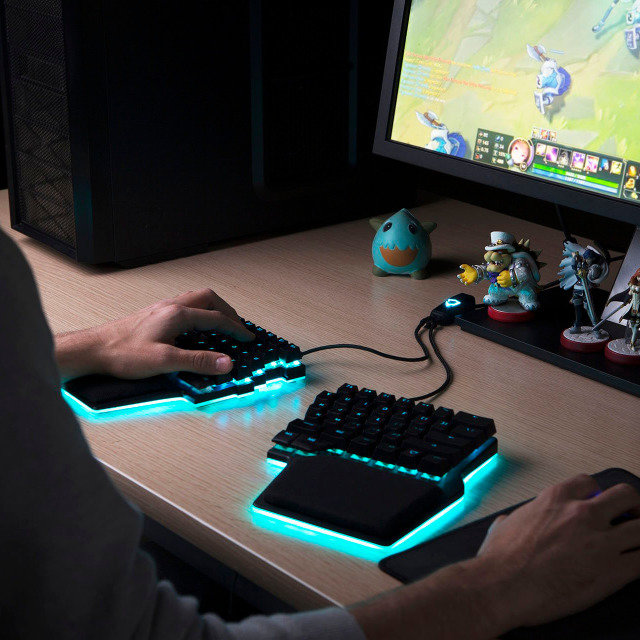
Dygma Raise is an ergonomic keyboard designed to increase gamers' performance, health and comfort.
Latest Updates from Our Project:
Fri Mar 9 '18 Announcement
about 8 years ago
– Fri, Mar 09, 2018 at 03:24:12 AM
Hey there backers!
As you all well know we always love giving you guys updates on the Raise keyboard. We’ll be posting weekly development updates just so everyone is informed with what is happening, not only with the keyboard, but also with our team!
Dygma continues to grow and expand!
Mirrors to Distribute the Underglow in the RAISE Keyboard
In our previous video, we talked about the light pipe idea using powerful side-mounted LEDs. We also found the optimum length of the canals to prevent the light from mixing too early, but allowing it to mix early enough around so we get a good blend.
But now we’re experimenting more with mirrors.
It was surprisingly good to see the even distribution of the light with the mirror. This means that we might not need to use side-mounted LEDs. We could use normal LEDs, like in the switches, and have the same effect.
The advantages of this would mean that it would be cheaper and easier, at least for our testings.
Matt’s Quick Update on the ARM Port Progress
We’ve been doing some really good progress with the ARM port using the SAMD21 chip.
It uses only 8% of the available program storage, which is excellent.
Moving forward, we still need to store the layers in the simulated EEPROM.
Ever wonder how sensors work to detect the keyboards’ connection?
Underneath the keyboard we have the Hall effect sensor which can detect magnets, and essentially detect whether the keyboards are plugged together or not. We will also have magnets on the joint, the piece that connects the split keyboard.
Our newest team member!
Dygma welcomes the newest member of the team, Dominique!
She will be handling the majority of the communication side of the company. She will manage blog posts and social media posts, as well as create some cool content for Dygma.
We welcome her with open arms and look forward to her growth within the company. :)
As always we appreciate your feedback and comments. They truly help us improve and allows us to give you the best service and product possible.
Fri Feb 23 '18 Announcement
about 8 years ago
– Fri, Feb 23, 2018 at 04:45:24 AM
February Raise development updates
Hey dear backers! We are very excited about the development that is underway on the project. We want to share with you some updates from our product design team. We hope you like it! Here are the list of updates on the product:
New Advancements in the Huble Design.
How We Are Connecting the Split Keyboard
Tenting of the Raise Keyboard
Underglow: How To Get The Perfect Blend
New Advancements in the Huble Design
In the last video, we discussed the different shape designs we would use for the Huble. Now, we have created a new shape that is more curved and smaller; and fits better with the cables. The Huble has:
2 USB-C ports to attach the cables connecting to each keyboard.
1 USB-C port to attach the cable to the computer.
An extra USB port at the back.
For the Huble’s finishing, we have used the same material as the keyboard. We can have 2 colour options: dark gray and silver.
How We Are Connecting the Split Keyboard
Like all keyboards, its body is full of electronics. This is a challenge for us to create the crucial part that joins the 2 keyboards together. It has to be a resistant and strong piece because it will enable both keyboards to connect. It needs stability. We are working with a unique shape that uses magnets and different metal fittings. In our first keyboard, we already used a metal connector, but it was not as resistant as how we wanted it. We felt that we could improve this design to build a better product. We had worked with an aluminium connector, but it was not resistant enough. We concluded that aluminium wasn’t the right material for this important piece. We then moved to a nylon material, a technical plastic that is good for assemblies. We have started prototyping the piece using 3D printing. But we continue to talk and discuss options with specialised mechanical engineers. We want to guarantee that we create the best solution for this part of the keyboard. :)
Tenting of the Raise Keyboard
Tenting is the inward inclination of the keyboard. This is an ergonomic design that is good for your wrists when using the keyboard for long periods of time. We are working on various ideas to get the right design for the Raise keyboard. We want it to have an adjustable tenting feature. Our last idea was to create a plastic piece underneath the keyboard. With this piece, you can adjust the height of the tenting you want by moving it sideways. You can use this plastic piece vertically or horizontally. This is one of our latest ideas but we would be like hear from you. Do you have any feedback about the different tenting solutions you know? And is tenting important for you?
Underglow: How To Get The Perfect Blend
We have been working on the evenness of the Raise’s underglow lights . We had found some much more powerful sideways-mounting LEDs. This is a big accomplishment for us. This will allow us to continue with the light pipe idea. We also found the optimum length of the canals to prevent the light from mixing too early, but allowing it to mix early enough around so we get a good blend. The next thing we need to do is make a version of the underglow PCB that we can control with the existing LED controller. We have worked hard to make sure the design and features of the Raise meets the needs of our customers. We will keep you posted on our developments! At the same time, we would appreciate your feedback and comments as we move forward.
Tue Feb 6 '18 Announcement
about 8 years ago
– Tue, Feb 06, 2018 at 12:42:49 AM
Raise is split into 3 main pieces; the 2 halves and the Huble. The Huble is the small enclosure in the join of the cable.
As well as containing the main microcontroller it also has a USB socket for extra connectivity. We have been using Atmel’s ATMEGA32U4 microcontroller during the development of Raise. The chip is easy to work with, is the default chip for the Kaleidoscope firmware, and is well supported in terms of libraries and the Arduino IDE.
The problem
One major problem with the chip is its cost and limited memory.
At the moment we can only store 3 layers in the EEPROM (a type of memory that doesn’t get lost when power is removed). To store 10 layers, we could add an extra memory chip to the board but of course adding extra memory also increases the cost.
There are other devices in Atmel’s AVR family that we could substitute, for example the AT90USB1286 which has 4 times as much EEPROM but unfortunately is nearly double the price of the 32U4.
The solution
To solve this issue we are currently investigating the possibility of moving to an ARM chip that both costs less and has more memory. It also makes the Huble more future proof, with more speed, program space and RAM. It sounds like a win-win, but ignores the development cost of moving to a different architecture. In summary, the development work includes:
Choose an ARM chip – most likely the ATSAMD21G18A Port the Kaleidoscope firmware (majority of work will be KeyboardioHID and I2C communications to the 2 halves Ensure USB connectivity – make sure it works on Windows, Mac and Linux (and BIOS) Bootloader functionality – possible to update firmware in the future. EEPROM is simulated in FLASH on the ARM chip, check this isn’t a problem with many configuration changes.
The Kaleidoscope firmware is written in a way that makes it easier to modify. Part of this comes from making sure the firmware is compatible with the Arduino IDE. The ATSAMD21G18A is already supported by Arduino, and is used in the Arduino Zero board. This should make the process of moving easier and less risky.
Our plan
We’ve had estimates made by 2 ARM programmers, who expect about 4 weeks of work will be required to make the changes and verify everything is working correctly. The biggest changes are those required to make the USB HID (human interface device) parts work correctly. We’ll start by modifying that part so we can check the basics, and which should put us into a good position to make a final decision on whether to switch the microcontroller from AVR to ARM.
Mon Feb 5 '18 Announcement
about 8 years ago
– Mon, Feb 05, 2018 at 10:11:22 AM
Hey dear backers!
This is the 1st update since the Kickstarter ended and move to Indiegogo InDemand. You can read past updates here:
 For the Huble’s finishing, we have used the same material as the keyboard. We can have 2 colour options: dark gray and silver.
 Like all keyboards, its body is full of electronics. This is a challenge for us to create the crucial part that joins the 2 keyboards together. It has to be a resistant and strong piece because it will enable both keyboards to connect. It needs stability. We are working with a unique shape that uses magnets and different metal fittings.
  In our first keyboard, we already used a metal connector, but it was not as resistant as how we wanted it. We felt that we could improve this design to build a better product. We had worked with an aluminium connector, but it was not resistant enough. We concluded that aluminium wasn’t the right material for this important piece. We then moved to a nylon material, a technical plastic that is good for assemblies. We have started prototyping the piece using 3D printing. But we continue to talk and discuss options with specialised mechanical engineers. We want to guarantee that we create the best solution for this part of the keyboard. :)
 Our last idea was to create a plastic piece underneath the keyboard. With this piece, you can adjust the height of the tenting you want by moving it sideways. You can use this plastic piece vertically or horizontally. This is one of our latest ideas but we would be like hear from you. Do you have any feedback about the different tenting solutions you know? And is tenting important for you?
 We also found the optimum length of the canals to prevent the light from mixing too early, but allowing it to mix early enough around so we get a good blend. The next thing we need to do is make a version of the underglow PCB that we can control with the existing LED controller. We have worked hard to make sure the design and features of the Raise meets the needs of our customers. We will keep you posted on our developments! At the same time, we would appreciate your feedback and comments as we move forward.