Dygma Raise- World's most advanced gaming keyboard
Created by Luis Sevilla
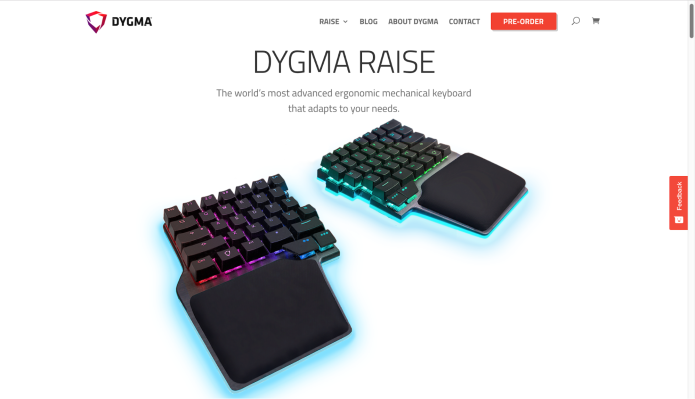
Dygma Raise is an ergonomic keyboard designed to increase gamers' performance, health and comfort.
Latest Updates from Our Project:
Wed May 30 '18 Announcement
almost 8 years ago
– Wed, May 30, 2018 at 05:50:36 AM
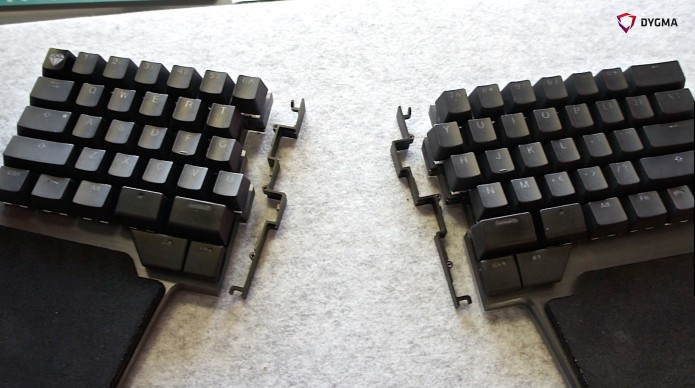
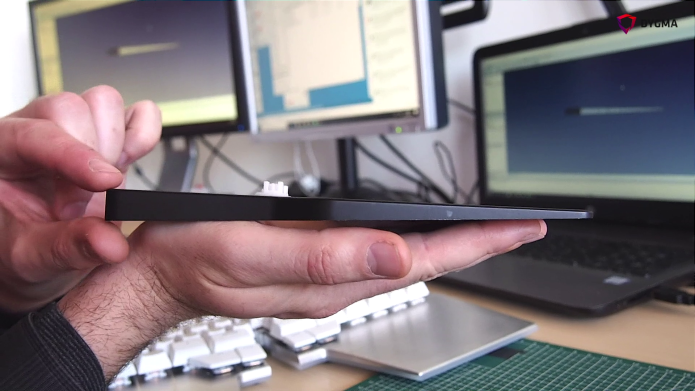
What’s interesting and unique about the Raise keyboard is that it’s a split keyboard that can be attached and detached. And finding the best solution to achieve a good design for this feature can be challenging.
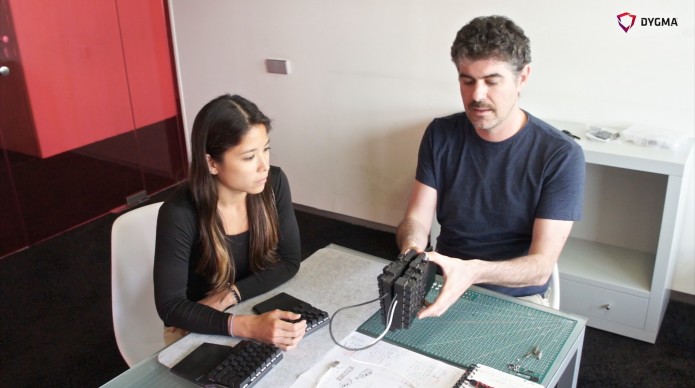
Watch Dominique and Manel talk about its evolution in the video below.
We knew that we wanted a great solution for this feature. So we have been working on this design since the beginning of the project.
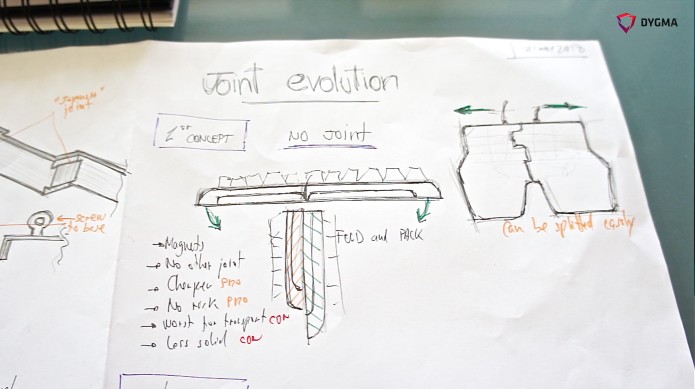
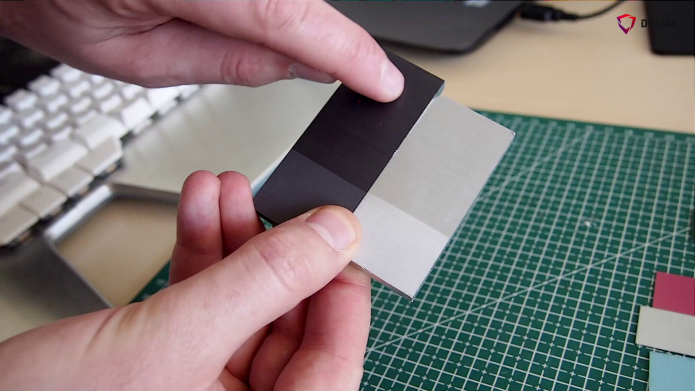
Our first concept: No joint, just magnets
Our first prototype did not have a solid piece or a joint, to connect them together. It only had magnets to join the two halves. It would stay connected if you moved it around the table but it detached easily when picked up. It wasn’t as strong and sturdy as we had wanted it to be. We wanted the connection to be more stable and solid. So we moved to our second concept.
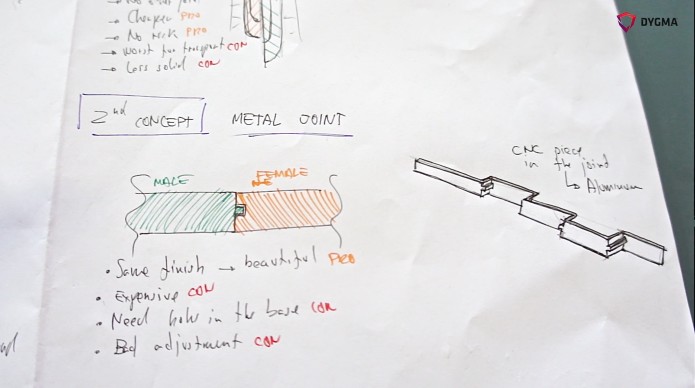
Second concept: The metal joint
For the second prototype we used a metal joint. Each side of the keyboard had the joint soldered. One had the male interface, and the other had the female. The joint piece is made of CNC aluminium which looked well suited for the aluminium body of Raise.
It was clearly stronger than the previous prototype. It also used magnets so the resistance was better. But we realised that the fitting was not that reliable. After continuous use (constant detaching and attaching), the joint wore down. The connection became less rigid. So we decided again to build on the next concept, the plastic joint.
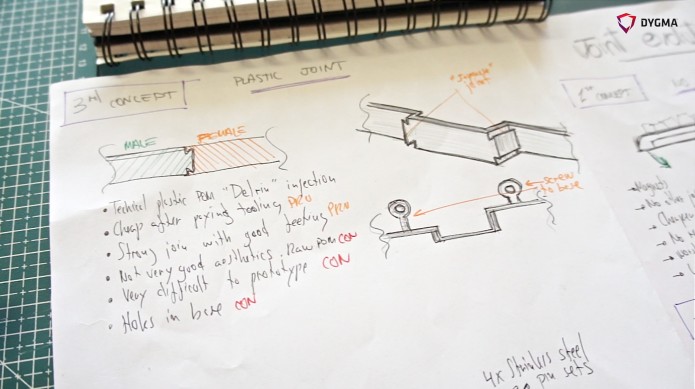
Third concept: The plastic joint
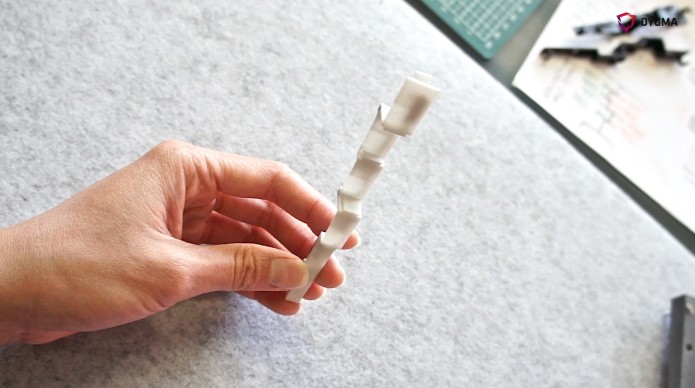
This was a cool concept for us. We used a technical plastic, POM, also called Delrin, to create the joint. It was a Japanese joint: a male and female joint with a widening shape that had more optimal surface contact.
We were so close in reaching the final objective with this concept. We even created a plastic block to test with our keyboard.
But it was difficult to prototype and also difficult to modify. We had to take into account that this concept could be too risky especially for a product such as Raise. This led us to our fourth and final concept, the metal pins.
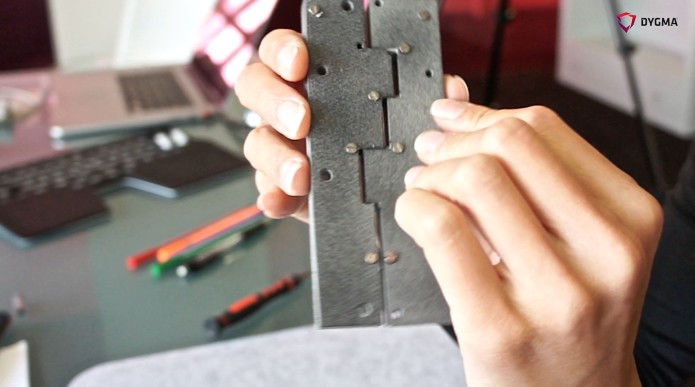
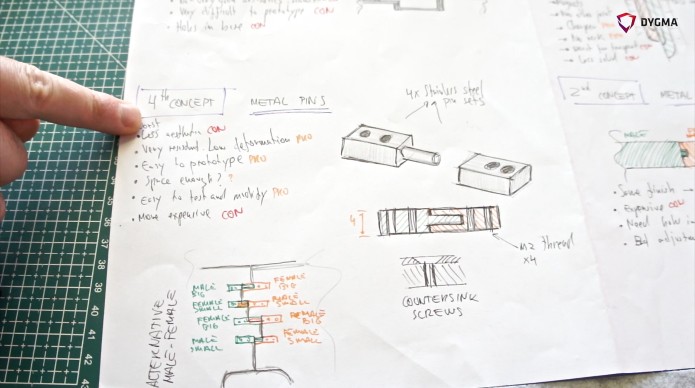
Final concept: Metal pins
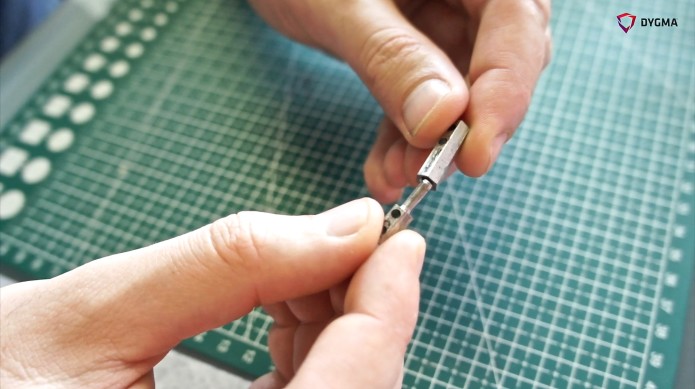
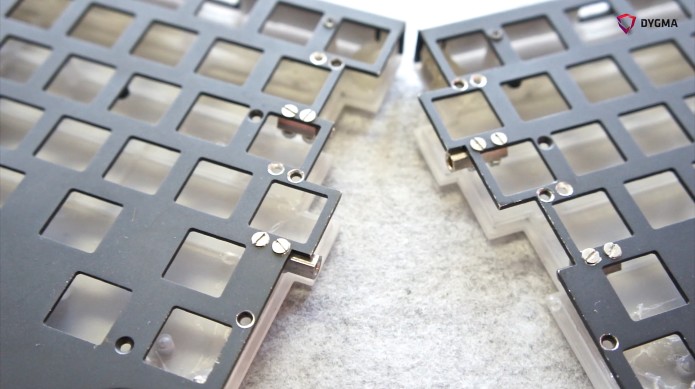
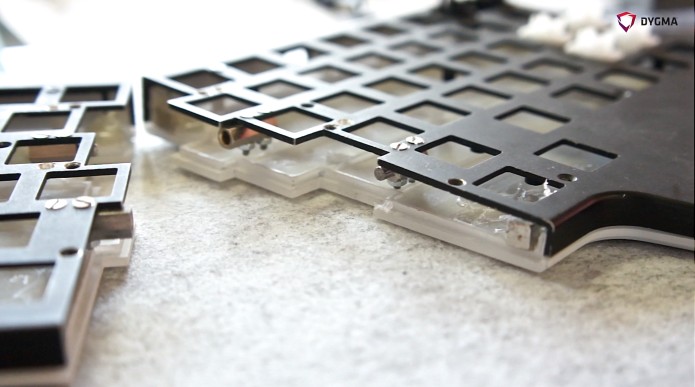
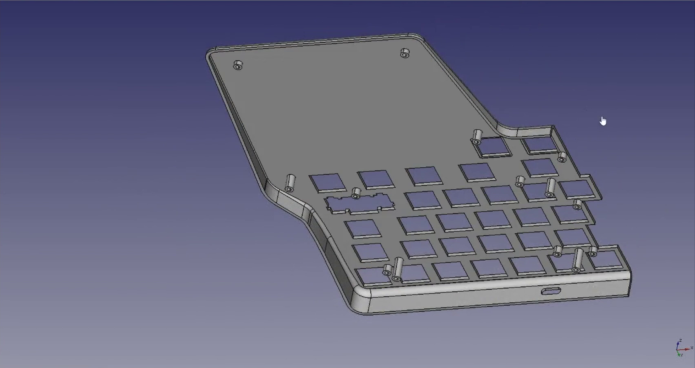
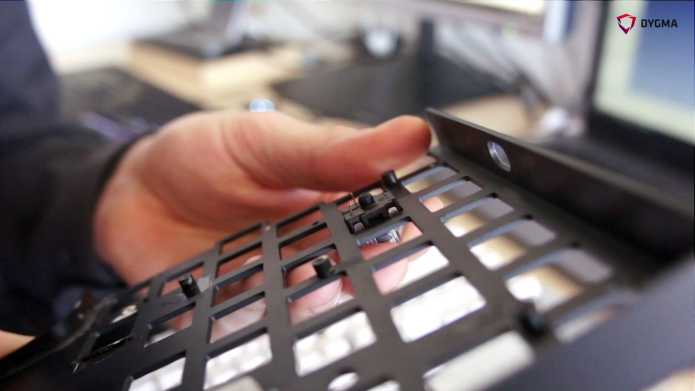
The metal pins are made of stainless steel. They are easier to modify and they do not wear out. We first tried attaching 4 metal pins in the keyboard but now we are only using two.
It’s easy to attach and detach the keyboard using these pins. And it’s more stable. It also uses magnets to give it a better feeling.
We’ve learned a lot from this concept. For example: when we attach the keyboard, we apply more force at the bottom (where the palm rests are). So we need stronger magnets in the bottom and weaker magnets at the top. We also realised that we need shorter pins in the top and longer pins at the bottom.
Now we’re in the process of finding the right balance for strong joint, while still maintaining the easy feeling when detaching and attaching the keyboard.
We want users to feel comfortable attaching and detaching the keyboard. But when it’s attached, the keyboard needs to be firmly and completely linked.
Manel is now in China for a few days. He will be meeting with our manufacturers to discuss the next steps of development.
We will post an update next week with all our progress.
Thanks ever so much for following!
Sat May 26 '18 Announcement
almost 8 years ago
– Sat, May 26, 2018 at 10:31:09 AM
Hey guys,
There have been many developments in the last 2 weeks.
Backerkit
We had started sending out the Backerkit survey to our super/ early bird backers with the intention of sending the remainder of surveys right away.
But then we received a few queries and realised that there were things that we missed to communicate with the first backers.
Therefore we had to pause sending out the surveys in order to make these adjustments.
Good news is that starting next week, we will start to send them out again!
These were the survey queries.
1. What are included with the Raise keyboard?
1x Huble
2x cables 15cm. Raise to Huble
1x cable 1.5m. Huble to computer
2x palm pads (one left, one right)
1x set of English keycaps*
1x keycap puller
1x set of switches of your choice
1x set of test switches (1 unit of every switch we offer. We offer 7 switches.)
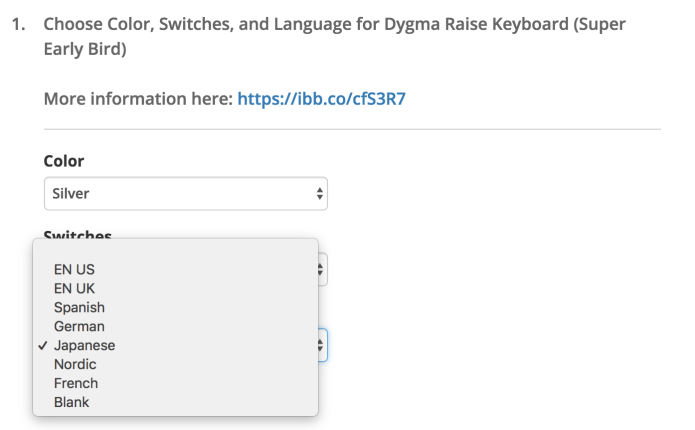
2. The Raise keyboard comes with a set of English (US or UK) PBT keycaps by default.
So you can select a second set of keycaps with the language of your choice, as shown in the image below.
However, if you choose English (US or UK) as your language, we’ll no longer send a second set of keycaps.
You can, however, select blank keycaps as your second set!
3. What mechanical switches to choose
Dygma Raise comes with 7 different types of switches, 3 from Cherry MX and 4 from Kailh. There are also 3 types of low profile switches for the thumb keys.
You can read more about the switches that we offer and each of our preferred ones here.
The Kailh Low Profile switches come with the type of switch you've chosen.
(Linear) With Cherry MX Red and Kailh Speed Silver > you get Kailh Low Profile Red
(Tactile) With Cherry MX Brown and Kailh Speed Copper > you get Kailh Low Profile Brown
(Clicky) With Cherry MX Blue, Kailh Speed Bronze and Kailh Speed Gold > you get Kailh Low Profile White
Our logistics are overly complex as it is because of all the different pledges, switches options and languages. We have issues with our suppliers because of our low order quantities. We had to draw the line somewhere and we thought that reducing the Low Profile switches options would be the least limiting for our backers. After all, there are only 4 low profile switches, the 4 under-row keys.
However, if you really want to have a different set of low profile switches, we can do this manually but it may take some time. You can send us an email and we will try to work this out for you.
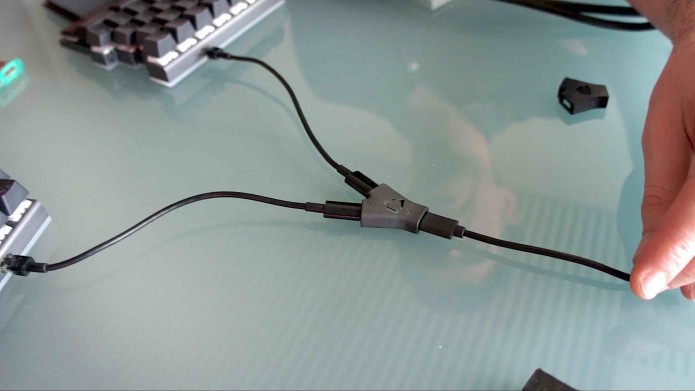
Other than this, we’ve also had some developments with the Huble.
Last week, we posted an update about the Huble and the challenges that we’ve encountered.
We provided 3 options and around 175 of our backers gave us their preferred choice.
Options and percentage of backers who preferred it:
Option 1 - Have a thicker cable for the Huble-to-computer, with two USB connectors at the end: connector 1: for the Raise, to drive power and send and receive data; connector 2: for the electronic device that you plug in the Huble. - 25.14%
Option 2 - Remove the hub - 52.57%
Option 3 - Keep the USB with the thin cable - 21.71%
Since then, our CTO, Matt, and Product Manager, Manel, have been working, designing and prototyping different ideas for the new Huble.
USB hub chip
“The problem is power. If you don’t provide extra power to a hub, the electric current used will be limited. This can lead to instability. One situation that can happen is your flash disk won’t be recognized by your computer.
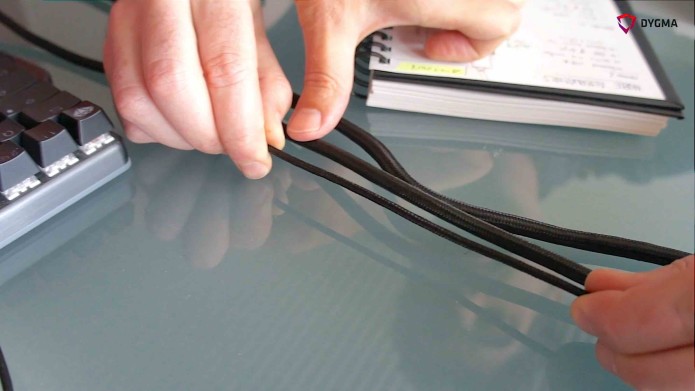
This is actually the reason why some keyboards, like Razer and Corsair, use these thick cables. They don’t use a hub. Instead, they run another cable inside the thicker cable as an extension.
Razer and Corsair cables in comparison to the original cable of the Raise - Huble to computer
We really wanted a thinner cable for our Huble but we came to the realization that it’s not possible.” - Matt Venn
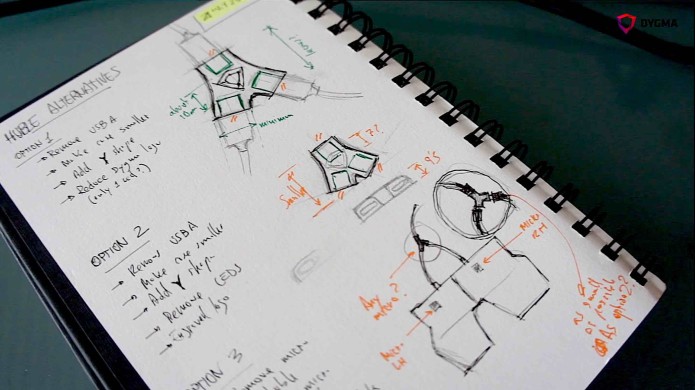
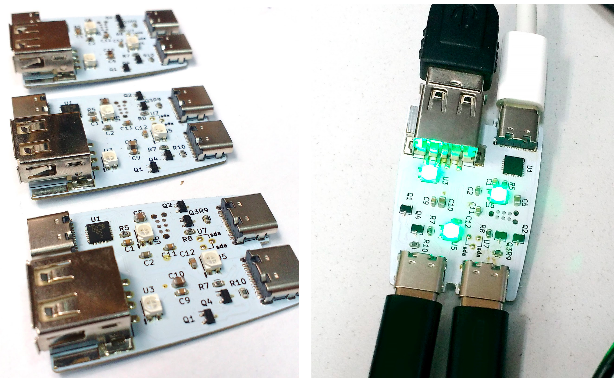
Manel has also been creating different designs of the Huble without the hub. He has drafted and prototyped 3 iterations.
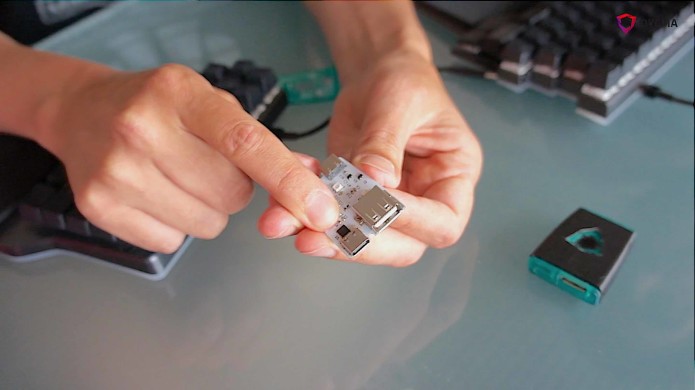
Huble alternatives
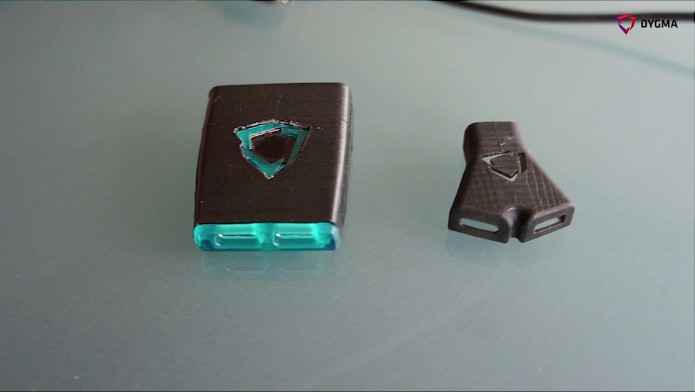
“The final design is big enough to fit all the electronics, and integrates well with the keyboard. The aesthetics is important. The new piece has round edges which makes it look more beautiful. It will also still have the RGB lights glowing through the Dygma logo.” - Manel Senís
New Huble without hub
2 options: use a thicker cable for the hub and keep the design or remove the hub
We have reached a conclusion that we will now go with 2 options:
Keep the Huble design; and have a thicker cable for the Huble-to-computer, with two USB connectors at the end: connector 1 - for Raise, to drive power and send and receive data; connector 2 - for the electronic device that you plug in the Huble.
Remove the hub completely, and have a smaller Huble design and a thinner cable.
“The reason behind this is because we want to have a zero percent failure rate. We don’t want to have any instability in our product whatsoever.” - Luis Sevilla
After last week’s feedback, we assessed the relative importance of having all of our backers participate in this decision.
So please take time to answer this questionnaire to choose your preference.
It will take you less than a minute to complete. You can either click the link below or expect an email with the brief questionnaire.
We will start developing the final design once we know what majority of our backers want!
Thank you so much for your support guys!
Fri May 11 '18 Announcement
almost 8 years ago
– Fri, May 11, 2018 at 08:06:57 AM
Hello backers!
We know it’s been a while since our last update. A lot has been going on but we do hope that you bear with us as we move forward. We are trying to give the updates as soon as possible.
Our first update comes from China!
Samples from China
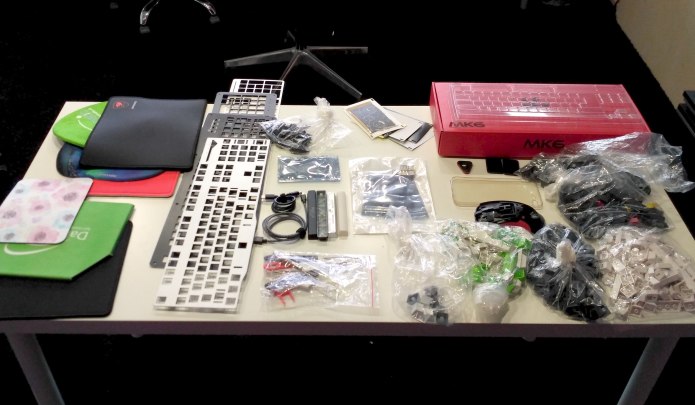
Last month, we received a lot of different samples from our manufacturers in China. Since then, we have been checking their qualities and the different pieces that we can offer with the Raise keyboard. We are constantly working with the manufacturers to make sure we get the best materials for our product.
Here’s a list of what we’re working on:
- Anti-slip materials and neoprene foam samples for the palm pads
- Different USB C cables - braided, with aluminum casing, with different colors
- Different stabilizers
- Mylar plastic that can used at the bottom of the keyboard
- Different keycaps - with different materials - PBT double shot, ABS laser etched, etc
- Polycarbonate materials - to diffuse the underglow lights
- MPU anti-slip materials
- Different metal structures of anodized aluminium, some with brushed finishing, some sandblasted
- Different keycap/switch pullers, o-rings, and other accessories
Given all these samples, we have already selected the final pieces for the components of the Raise.
For phase 3, we were able to test the packaging prototype with a few of our backers.
The main assumptions that we wanted to validate:
The user can assemble the switches and the keycaps of the keyboard
The user can do it easily and enjoy the experience.
Here are our conclusions:
The packaging concept was well understood.
The keyboard can be assembled by the user - some people took more time than others but it can be done.
We need to test the prototype with more users so we can create more iterations and improve the packaging.
How would you feel if you received the keyboard with separate boxes for the switches and keycaps, and you learned how to assemble them yourself? Would you find this interesting? Or would you prefer to receive the keyboard with everything assembled?
The reason it has taken so long is that we had to finalise all the different materials with our product development team and the manufacturers from Shenzhen. And considering that the Raise has multiple add-on options, it took some time for us to input all the variants for all the pledges. It’s a lot of work but we’re nearly there! Also, we had added a more add-ons for you guys to get additional accessories.
Thank you so much for your patience. You can expect an email with the survey next week.
New Website
As we mentioned in our previous update, we have been developing our new website.
It is currently live but it’s in Beta. We are still working on fixing bugs and improving the overall user experience. We would appreciate it if you head over to https://dygma.com/ and give us your comments. As you know, we grow because of all of your constant feedback. There is an icon on the right-hand side of the screen where you can rate your experience.
Thanks again guys!
Mon Apr 16 '18 Announcement
almost 8 years ago
– Mon, Apr 16, 2018 at 02:42:36 AM
Hi there guys,
Here’s a short recap of what’s been going on in Dygma in the past few days.
The Huble.
We have been working and testing the prototypes of the Huble.
-The industrial design is finalized, now we are working on the DFM (design for manufacturability) with the factory in Shenzhen.
--Doing a lot of testing with the usb hub specifications.
-Working on the connection of the aluminum lid to the plastic base without using screws.
Prototyping Packaging Concepts for the Raise keyboard.
We would like to test the idea of selling the keyboard, the keycaps, and switches in different packages.
Reason being is that this KB has removable switches, and some backers have asked for different switches and also different keycap languages. We will teach you how to fit and remove them properly.
This can enhance the UX and create a culture in our community.
We haven't finalized this idea yet. We would like to test it with a few of our backers and of course, with you guys!
Dominique’s interview with Manel about the Body of the Raise keyboard.
Many of you have been fascinated with the unique build of the Raise keyboard. In this video, Dominique asks Manel some questions about the characteristics of the body of the keyboard: its finishing, the molded structure, how it’s assembled, and how the electronic components are connected.
We are currently working on a new design for our website!
In the new site, you will be able to pick your switches, keycaps, and language, and buy your customized Raise keyboard from there!
We also intend to give you more interesting content about your mechanical switches and the many benefits of an ergonomic keyboard.
So stay tuned!
Mon Apr 9 '18 Announcement
almost 8 years ago
– Mon, Apr 09, 2018 at 02:12:16 AM
Dear backers,
We are trying as much as possible to compile all the updates we have during the week. This will allow us to give you a more thorough and complete update. So we apologise if this weekly update has taken a bit longer than expected.
Here are our updates for March:
Trip to Shenzhen Part II – The Pearl River Delta
Manel Senís, our Product Manager, had a trip to Shenzhen in January of this year. He visited numerous factories and agencies. His goal was to find the best partners and high-quality manufacturers for the Raise keyboard, and for Dygma’s future products.
The palm rest feature is important for all users. It gives support to both your hands when using the keyboard. It neutrally positions your hands thus reducing strain on your wrists when using the keyboard for long periods of time.
Not fixed
The palm rest can be removed easily from the keyboard.
It will have an anti-slip material.
Cleanliness
The material of the palm rest can be easily cleaned.
Materials
The base material is a neoprene foam.
The top material is a fabric that wraps around the foam.
Thickness
It will be between 3mm - 5mm.
Eventually, we will be able to provide different thicknesses for individuals.
Prototyping Packaging Concepts
We are currently prototyping packaging concepts for the Raise keyboard.
As you might know by now, especially if you've been following our page, that we dedicate a lot of time and hard work in the development phase of all the Raise's features. The packaging is an important aspect as this is our customer's first experience with our product.
We are testing with users the different dimensions, materials, and designs.
One big characteristic we are excited with is the user-experience when opening the package of the Raise. What will they expect? Hmmm. ;)
As always, we will keep you all updated with our developments.
The Body of the Raise keyboard
The finishing of the keyboard
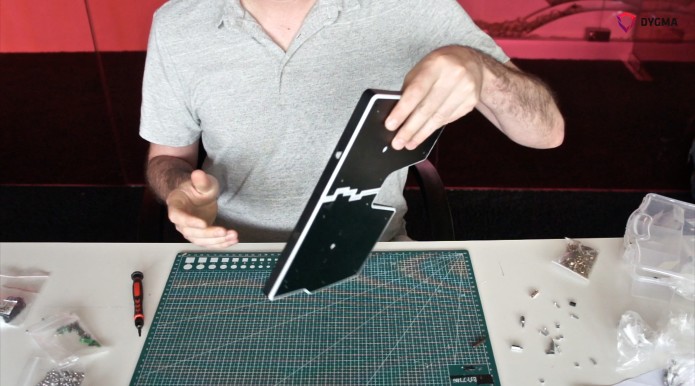
The Raise’s body is made of anodized aluminum. After asking a few backers and gamers, we had the consensus of 2 colours: dark gray and silver. We also chose 2 different finishing: brushed and sand blasted. These create a different texture on the body.
How the structure is created
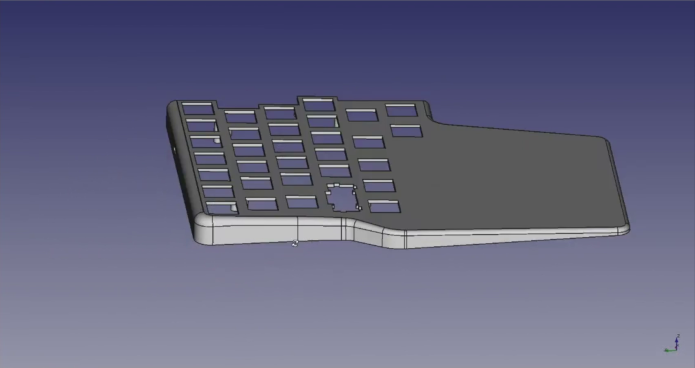
We finally decided to use a different industrial process to create this structure. The process is called stamping. This process uses a mold and presses the aluminum sheet metal to create the shape we want. This shape will also be anodized.
The round edges were a challenge for us but we have worked with the manufacturers to get the most aesthetic angles best for the keyboard.
As for the round radius, at the back of the keyboard there is a 4.5 millimetre radius, and the front has a 1.5 millimetre radius. We did this because the keyboard has a 3 degree tilting, which after many prototypes, we concluded is the ideal amount.
The process of creating this design is challenging because we are going to the limit of the technology to get the shape we like. But we believe that the round edges are important in a functional point of view because we don’t want to have sharp edges. At the same time, in an aesthetic point of view, it looks better.
How the body of the Raise is assembled
The Raise is assembled in an automated factory. Initially, the screws were found at the top of the keyboard but we decided to change this. Now, all the screws that are used to assemble the keyboard are found at the bottom using threaded inserts.
How the electronic components are connected
We have our main PCB and another PCB for the low profile switches. We connect the PCBs using the inserts. The PCB and the switches are independent from each other. For this reason, you can change your switches.
The switch hole also needs to have the exact dimensions as we take into consideration the easy removal and fitting of the switches.
We also need to customise the thickness of the holes. For the regular switches, the thickness of the holes is 1.5 millimetres, and for the low profile switches, it’s 1.25 millimetres.
How we measure the Raise's latency and jitter
In this tech video, Matt explains how we are measuring the Raise’s latency and jitter and why this is important for gamers.
Stay fully updated with all our developments and stories by following us on our social media channels.
Help us grow our engagement and reach by giving our posts a ?or a ❤️. Your comments and feedback are always appreciated.